
Choosing the right Bed Side Cabinet is a small decision with daily consequences. It affects reach, room safety, storage, and visual balance. A cabinet beside the bed should hold essentials without forcing you to stretch, bend, or search in darkness. Measure the mattress height first. Then check the cabinet’s top surface, drawer clearance, and walking space.
The data supports a careful approach. The American Academy of Sleep Medicine and the Sleep Research Society recommend that adults receive at least seven hours of sleep nightly. A stable bedside surface can support healthier routines by keeping water, glasses, medication, and a reading light within reach. The U.S. Consumer Product Safety Commission also continues to highlight furniture tip-over risks, especially around children. Anti-tip hardware and a solid construction therefore matter more than decorative styling alone.
Consider the room in real use.
Grand View Research’s furniture market analyses identify growing demand for functional, space-efficient furniture, particularly in compact homes. That trend makes vertical storage and narrow cabinet designs increasingly practical. However, market popularity does not guarantee comfort or quality. A cabinet may look elegant online yet feel unstable beside a moving bed. I would inspect drawer runners, edge finishing, material thickness, and hardware before judging its appearance. These details are easy to overlook.
This guide compares size, materials, storage, safety, ergonomics, and design. It also questions common assumptions. More drawers are not always better. A cheaper cabinet can cost more when repairs, replacement, or poor sleep become part of the decision. Consider the room, the user, and the next five years—not only today’s photograph.
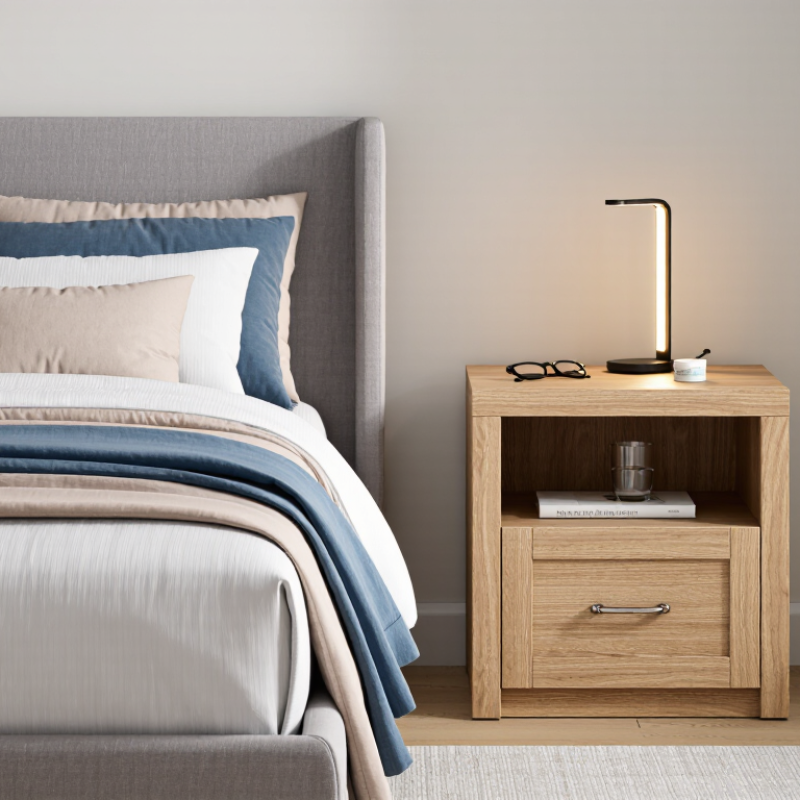
A bedside cabinet should sit close to mattress height, making essentials easy to reach without a stretch. For many beds, 24–28 inches (61–71 cm) is a useful starting range, not a fixed rule. Measure from the floor to the top of your mattress, including any topper. Then compare that number with the cabinet’s usable top surface. A lamp, book, and glass of water should fit without crowding the edge. Small differences matter. A cabinet several inches too low may feel awkward, while one that is too high can make reaching across the bed uncomfortable.
Tips: Sit or lie in your usual sleeping position and reach toward the proposed cabinet height. Check drawer clearance against the bed frame, too. A tape measure and a stack of books can help you test the height before buying. This quick test is imperfect, but real reach often tells you more than a product photo.
Consider what you keep beside you overnight. A phone and reading glasses may need only a compact surface; medication or charging cables may call for a drawer or open shelf. Leave a little room around the lamp base, and check that cords can reach the outlet without pulling. If your mattress height changes seasonally, reassess the fit. Comfort is personal, and the benchmark may not suit every bed or body.
For 2026, start with the space beside the bed, not the cabinet you saw online. A depth of 16–20 inches (41–51 cm) suits many bedrooms, but measure the actual walking route first. Leave enough room to pass without turning sideways or catching a hip on a drawer pull. In a tight room, even a cabinet within this range may feel bulky. Measure from the wall to the bed edge, then account for open drawers and nearby doors. A tape measure on the floor helps. It is less glamorous than shopping, but more reliable.
Match the cabinet height to the mattress top, or keep it slightly lower for easy reach. Check whether a lamp, phone, and water glass fit without crowding the surface. The American Home Furnishings Alliance’s furniture tip-over guidance points to ASTM F2057, a safety standard for clothing storage units; it does not set bedside-table dimensions, but it reinforces the value of checking stability and intended use. Do not assume every small cabinet falls under the same requirements. A narrow footprint can be practical, yet a tall, lightly loaded unit may wobble. Test drawers in person when possible. Measure twice. Room layouts vary, and I have found that the “perfect” depth can still block a closet door.
2026 How to Choose the Right Bed Side Cabinet?
Prioritize Safe Reach by Applying ADA’s 15–48 in (38–122 cm) Range
A bedside cabinet should keep daily essentials close without forcing an awkward stretch. The ADA’s 15–48-inch reach range offers a useful accessibility reference, not a furniture-specific rule. Check the height from the position you actually use: sitting on the mattress edge, standing beside the bed, or using a mobility aid. Reach varies with posture.
Place the cabinet so its top and storage are easy to access. A lamp switch, water glass, and phone should be within comfortable reach, while drawers should open without striking the bed. Measure from the floor, then compare the cabinet height with your mattress. Mattress height can change after adding a thick topper. A tape measure helps. So does a real test.
The 15-inch lower point can be especially relevant for accessible storage, while the 48-inch upper limit helps prevent high, difficult reaches. Keep frequently used items in the reachable zone, and avoid stacking objects above it. For a seated user, clear space beneath a surface may also matter; a closed cabinet can block knees or a wheelchair. I once assumed a lower cabinet would always be easier. It was not, because reaching down beside a soft mattress felt unstable. Test the setup before settling on a size.
| Selection dimension | Practical target or check | Why it matters | How to apply it |
|---|---|---|---|
| Reach height for frequently used items | Keep controls and everyday items within 15–48 in (38–122 cm) above the floor where feasible. | The ADA Standards specify this range for accessible reach to operable parts in applicable settings; it is a useful planning reference, not a bedside-cabinet height requirement. | Check the height of the lamp switch, phone, glasses, and drawer pull—not just the cabinet top. |
| Cabinet-top height | Choose a top close to mattress height, then test it from the user’s usual seated or lying position. | Mattress heights and users’ mobility vary, so there is no single universally suitable bedside-cabinet height. | Confirm that items can be reached without excessive stretching, twisting, or leaning over the bed edge. |
| Reach over an obstruction | For an applicable forward reach over an obstruction, ADA maximum reach height is 48 in (122 cm) when the obstruction is no more than 20 in (51 cm) deep; it is 44 in (112 cm) when depth is 20–25 in (51–64 cm). | A bed, cabinet, or other obstruction can affect the permitted maximum reach height under the ADA reach provisions. | Measure the obstruction depth and consult the applicable standard when designing an accessible space. |
| Clear approach beside the bed | Preserve the space needed for the user, mobility device, and transfer; the required layout depends on the applicable accessibility standard and room plan. | A reachable cabinet is not useful if a wheelchair or walker cannot approach it safely. | Check the full route and transfer area, not only the gap between the bed and cabinet. |
| Drawer and door operation | Look for pulls that are easy to grasp and operate without tight pinching or twisting. | Simple, low-effort operation can make frequently used storage easier to access. | Test each drawer and door from the intended position; avoid placing essential items behind difficult-to-open fronts. |
| Stability and tip resistance | Choose a stable cabinet that does not rock during normal use; secure it as directed by its manufacturer when appropriate. | Pulling on a drawer or leaning against a light cabinet may cause it to shift or tip. | Check the base, drawer stops, and installation instructions, especially in homes with children or users who rely on support. |
| Electrical items and cords | Keep cords routed away from walking paths and transfer areas. | Loose cords can create a trip hazard, while accessible switches reduce the need to reach awkwardly. | Position lamps and chargers so cords do not cross the floor or become trapped by drawers. |
| Important standards note | ADA reach ranges apply to specified accessible elements and conditions; they do not set a general required height for residential bedside cabinets. Requirements can depend on the project, applicable code, reach direction, and obstruction. Verify the governing standard for the specific space. | ||
A bedside cabinet can do more than hold a book and a glass of water. Its height and position also affect where reading light falls. Aim for 300–500 lux on the page, rather than assuming the whole bedroom needs that brightness. Lux measures light reaching a surface, so the book matters more than the bulb’s advertised output.
Place the lamp so its shade sits near shoulder height when you are seated in bed. A focused, adjustable light can keep the page bright while limiting glare on the wall or screen. If you read with your right hand, try placing the lamp on the left; this can reduce shadows across the page. Check the setup after dark with the book open. A lux meter can give a useful reading at page level, though phone apps are only rough guides.
The cabinet should be stable, with enough top space for the lamp base and everyday items. Keep cords away from drawers and walking paths. I have found that a lamp can look well positioned in daylight, then feel harsh at night. It may take a small adjustment. If light spills into a partner’s eyes, angle the shade downward or choose a more directional beam, then reassess the page brightness.
2026 How to Choose the Right Bedside Cabinet?
A bedside cabinet should match your room, habits, and safety needs. Solid wood feels stable and can handle daily use, but it may be heavy and sensitive to humidity. Engineered wood costs less and offers consistent surfaces, yet damaged edges can swell after water exposure. Steel provides strength and easy cleaning, although it may feel cold beside a bed. Check the material thickness, joinery, drawer runners, and finish rather than trusting appearance alone. I once chose a cabinet for its attractive surface and regretted the weak drawer base.
Load capacity needs careful attention. A cabinet may support a lamp, books, a charger, and personal items without trouble. However, the advertised rating may apply only to the top panel. Look for separate limits for drawers and shelves. Test the cabinet after assembly, especially if the floor is uneven. A slight wobble matters more at night.
Storage should fit real routines. One drawer can hold glasses and medicines, while an open shelf suits books or a water bottle. Cable openings prevent cords from hanging across the floor. Tip-over protection deserves equal attention. Choose a wide base, smooth leveling feet, drawer stops, and anti-tip hardware for wall attachment. Interlocking drawers can prevent several drawers opening together. Keep heavy items low. Even reliable furniture can become unstable when overloaded or poorly assembled, so recheck every fastener after a few weeks.
Compare materials, load capacity, storage, and tip-over safety
How to use this chart: These approximate density ranges describe common material types, not the load capacity of a finished cabinet. Construction, joints, panel thickness, and hardware all affect how much weight it can safely hold, so check the maker’s rated load for the top and each shelf or drawer. Choose storage that fits your items, place heavier contents low, and secure a tall or narrow cabinet to the wall using the supplied anchoring hardware.